‘I bring thee tears, and sighs from the depths…’
This hymnal expression encapsulates the existential drama of the human fall and the ineffable mystery of renewal in Christ. Tears and sighs are not merely expressions of religious emotion, but may serve as testimonies to the active divine Grace, through which fallen humanity is reoriented towards its primordial and eschatological destiny: deification by Grace.
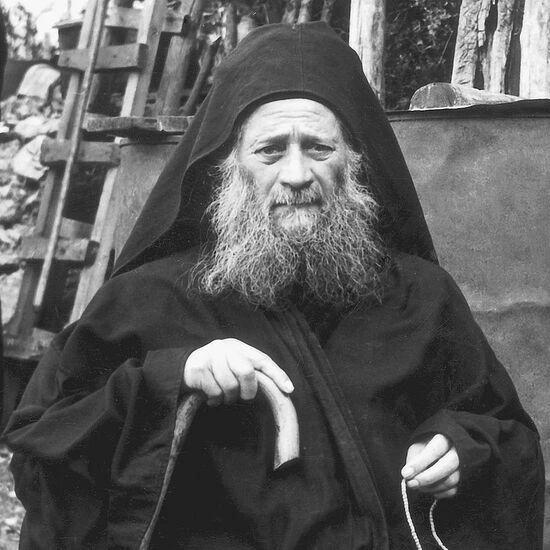
The life of Saint Joseph the Hesychast lends itself to a deeper theological interpretation, in which repentance, mental prayer and contrition of the heart are revealed as interrelated manifestations of man’s therapeutic journey towards communion with the Uncreated God.
Repentance as ontological renewal
In Orthodox patristic anthropology, sin is not limited to the transgression of a moral imperative. It constitutes a distortion of the mode of existence, a departure from what is natural, and the subjugation of the soul’s natural powers to self-love.
Man, created in the image of God and destined for likeness to Him, becomes trapped in the illusion of autonomous existence, mistaking alienation from the Creator for freedom.
According to Saint Maximus the Confessor, the healing of the passions is linked to the restoration of the natural movement of the human faculties towards God.
Repentance, therefore, is not moral self-improvement, but a therapeutic transformation of the mode of existence. The essence of human nature is not altered, but its passionate functioning is healed, so that the human will may cooperate freely with divine Grace.
Repentance thus becomes a foretaste of eschatological renewal.
Tears and the uncreated energy of God
‘I bring tears to you…’
In the Hesychast tradition, the tears of true contrition transcend the limits of a psychological reaction. When born of Grace, they are the fruit of the mystical cooperation between human freedom and divine energy.
Man offers his free will and his contrite heart, but he cannot compel the divine visitation.
Here the fundamental Palamite distinction between the divine essence and the uncreated energies is brought to the fore. God remains utterly inaccessible in His essence, but He truly communes with man through His uncreated energies.
Grace is neither a created mediation nor a subjective mental state, but the uncreated divine energy itself.
Tears are not to be equated with Grace, nor do they constitute an infallible criterion of holiness. They may, however, bear witness to the inner transformation of a heart that is being healed of self-love and seeks God.
The descent of the mind into the heart
The phrase ‘sighs from the depths’ takes on particular interpretative depth within neptic anthropology.
The mind, scattered by the senses and captive to thoughts, is called to return to the heart, the spiritual centre of human existence.
This return is neither a psychosomatic technique nor a method for inducing mystical experiences. It requires purification, sobriety, humility and the unceasing invocation of the name of Jesus Christ.
Mental prayer aims at the restoration of man’s inner unity and his unbroken connection with God.
Saint Joseph the Hesychast did not approach this teaching as an abstract philosophical system, but as a cruciform experience of unceasing spiritual struggle.
Mount Athos as a place of experiential theology
In the Athos desert, where human self-sufficiency is shattered in the face of the divine mystery, Saint Joseph, through his ascetic life, demonstrated the transition from intellectual knowledge of God to experiential communion with God.
At Katounakia, at Little Saint Anne and in the ascetic retreats of Mount Athos, the night was transformed into a time of prayer, silence into mental doxology, and the contrition of the heart into a place of reception for uncreated Grace.
For the Saint, Mount Athos was not merely a place of withdrawal from the world, but a field of cruciform self-offering, where the ascetic mortification of the passionate will opened the way to freedom in Christ.
Palamite theology did not remain there as an abstract dogmatic formulation, but offered the ecclesiastical language for interpreting the actual participation of created man in uncreated divine life.
Mount Athos is sanctified not primarily by the isolation of its peaks, but by the hearts of those who, through repentance, become dwelling places of the Holy Spirit.
Humiliation as the overcoming of self-love
The paradox of Christian asceticism lies in the fact that true spiritual renewal presupposes the crushing of the egocentric mindset.
Humility does not constitute an ontological devaluation of the human person, but rather their liberation from the illusion of self-sufficiency.
Where self-justification crumbles, the possibility of authentic communion emerges.
This brokenness, however, is not to be equated with despair. Orthodox repentance remains inconceivable without hope in God’s infinite mercy.
Saint Isaac the Syrian highlights, with particular spiritual subtlety, the brokenness of the heart, divine mercy and humility as fundamental dimensions of the ascetic life.
The heart is not healed when it justifies itself, but when it freely surrenders to God’s love.
From purification to deification
The ultimate goal of the hesychastic life is not individual moral perfection, but deification by Grace.
The purification of the passions and the illumination of the mind form part of the single path of transformation in Christ.
Man does not become God by nature, nor does he share in the divine essence. He truly participates in the uncreated energies of God, whilst always remaining a created being.
Theosis does not constitute the abolition of human nature, but its perfection through Grace.
This is precisely the deepest horizon of Mount Athos asceticism: not the self-deification of man, but his free, unforced and personal participation in the life of the Triune God.
Silence that becomes theology
In the person of Saint Joseph the Hesychast, theology regains its experiential and doxological character.
Silence is not the absence of sound, but freedom from the tyranny of thoughts. Prayer is not an intellectual approach to the Inaccessible One, but a personal communion with God, Who reveals Himself through His Grace.
‘I bring tears to You’ thus becomes a confession of human poverty in the face of divine riches.
Man offers his heart to God, wounded by the Fall, yet willing to be renewed.
And God does not spurn this offering.
For the ultimate mystery of Hesychastic theology is not that man manages, by his own powers, to ascend to God, but that God, out of infinite philanthropy, condescends to man and makes him a partaker of His uncreated life.
This is the deepest message of Mount Athos hesychasm: that man draws near to the ineffable mystery of God not when his words multiply, but when his heart becomes prayer.