
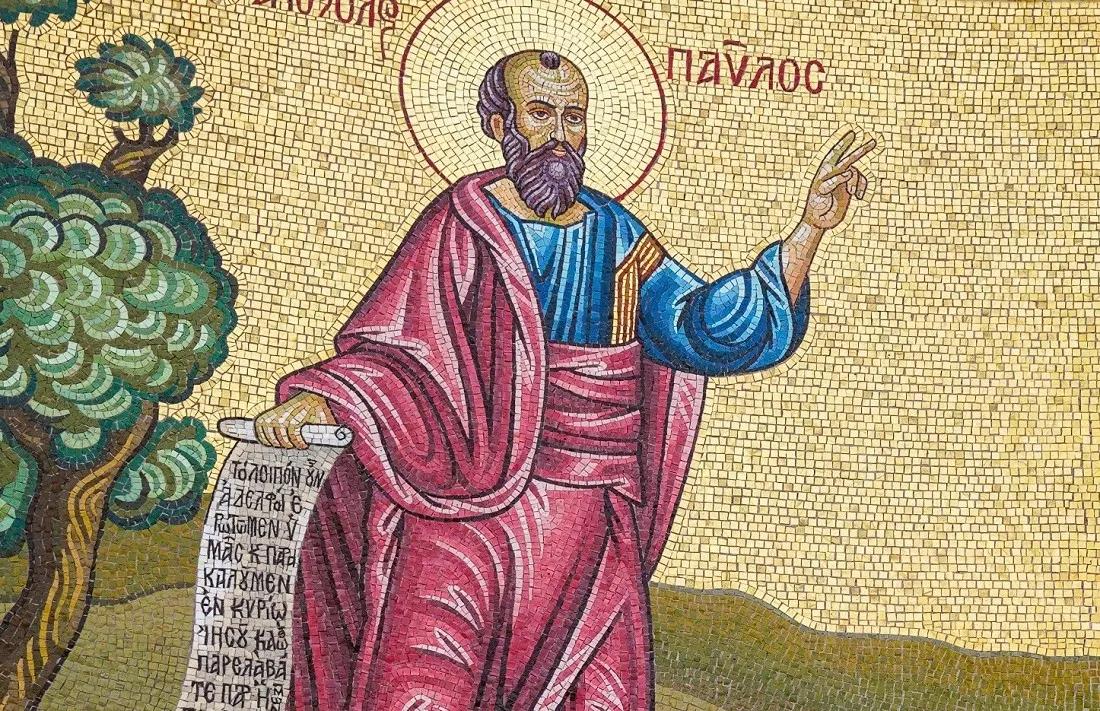
THE HYMN OF LOVE BY THE APOSTLE PAUL
Love as the supreme criterion of the spiritual life – A Mount Athos theological approach and our own self-criticism
Your cart is empty.
Love as the supreme criterion of the spiritual life – A Mount Athos theological approach and our own self-criticism
‘If I speak in the tongues of men and of angels, but have not love, I am but a resounding gong or a clanging cymbal.”
1 Corinthians 13:1
There are passages in the Holy Scriptures that do not merely admit of interpretation, but demand an existential defence. Passages before which human self-sufficiency is laid bare, self-justification crumbles, and the conscience is called upon to come to terms with its own truth.
One such discourse is the famous Hymn to Love by the Apostle Paul.
The Apostle to the Gentiles, with divinely inspired rigour, dismantles every form of spiritual self-satisfaction. Multilingualism, knowledge, prophecy, faith that moves mountains, and even the total sacrifice of one’s possessions, prove to be spiritually ineffective in terms of their soteriological purpose when they lack love.
‘And though I have the gift of prophecy and understand all mysteries and all knowledge… but have not love, I am nothing’.
How striking this apostolic declaration is! Paul is not merely saying that man lacks yet another virtue. He proclaims that, without love, even the seemingly highest spiritual state lacks its true fulfilment.
Love as ontological participation in the life of God
In Orthodox theology, love is not merely moral behaviour, an emotional disposition or humanitarian sensitivity.
The Evangelist John reveals its unfathomable theological depth: ‘God is love’ (1 John 4:8).
Love is not a quality added externally to God. It is inseparable from the divine life and is revealed to humankind through His uncreated energies.
Man’s participation in divine love, by grace, therefore constitutes a reality of communion with God Himself, without the created human nature being identified with the uncreated divine essence.
In the light of patristic anthropology, the absence of love bears witness to the tragic distortion of the human way of being. Self-love supplants communion, self-interest distorts self-giving, and the desire for self-affirmation transforms even the gifts into instruments of spiritual pride.
A person may possess knowledge of the truth whilst remaining, in an existential sense, alien to its spirit.
The Mount Athos experience and the transcendence of self-love
In the Mount Athos desert, where silence strips man of the illusions of his self-sufficiency, love is revealed as the fruit of purification and humility.
The true hesychast does not strive to attain supernatural experiences, nor to gain spiritual superiority over his brothers.
He strives to put self-love to death, so that his heart may become receptive to divine Grace.
In the tradition of Mount Athos, mental prayer, ascetic practice, vigil and self-restraint are not regarded as spiritual achievements in their own right. They are means of healing the human person and restoring his loving relationship with God and his neighbour.
Asceticism without love risks degenerating into self-satisfied self-discipline. Knowledge without humility turns into spiritual arrogance. And prayer without forgiveness risks remaining a mere external religious formality.
The monk who prays in the silence of his cell does not withdraw from humanity in order to despise it. He is called to hold the whole world within his heart, offering his own repentance and interceding with sorrow for every human being.
For authentic Mount Athos silence is not an escape from love, but a practice in its universality.
Our own self-criticism: Many languages, but how much love?
The apostolic message compels us to turn our attention inwards as well.
At the online shop Kastania – Monastic Products we aim to create a space for communication with people from different countries, languages and cultures.
We wish for our texts, the presentations of sacred icons, Orthodox books and the spiritual heritage of Mount Athos to be accessible to as many people as possible.
But it is precisely here that the words of the Apostle Paul serve as a stern examination of our own conscience.
What is the point of speaking Greek, English, Russian, Serbian, Romanian or any other language, if we fail to speak the one language that every human heart understands?
The language of love.
What is the point of possessing technological capabilities, knowledge, skills, organisational ability and every other gift that God’s goodness has allowed us to acquire, if we lack patience towards the demanding person, understanding towards the weak, and forgiveness towards those who wrong us?
What value is there in presenting the image of Christ if we do not endeavour to recognise His image in the face of our fellow human beings?
What value is there in offering incense, prayer ropes and spiritual books, if our own hearts remain indifferent to the spirit of humility that these things remind us of?
And what value is there in invoking the Mount Athos tradition if we do not strive to emulate, even in the slightest, the love, humility and self-reproach of the Fathers of Mount Athos?
We do not express these thoughts to tell others how they ought to live.
We express them, first and foremost, as a form of self-criticism.
For we know that it is easier to speak of love than to endure with love. It is easier to write about humility than to accept a rebuke. It is easier to present holiness than to confront one’s own spiritual poverty.
And if all that we create does not ultimately serve humanity with sincerity, respect and selflessness, then the apostolic word is directed first against us:
‘I have become a resounding gong or a clanging cymbal’.
A sound without spiritual substance. An outward activity without inner fulfilment.
Love as the ultimate criterion of spiritual life
The Apostle Paul concludes his hymn with a proclamation of unsurpassed theological depth:
‘And now these three remain: faith, hope and love; but the greatest of these is love’.
Love transcends every temporary gift, for it is not confined to the needs of this present life. It constitutes the very orientation of eternal communion with God.
Neither erudition, nor eloquence, nor ascetic rigour can replace love.
And perhaps the deepest tragedy of humankind is not that it is ignorant of the mysteries of God, but that, whilst it knows how to speak of them, it finds it difficult to love its neighbour.
That is why our own prayer is simple, even if the path to its fulfilment is difficult:
May God not allow us to acquire so many languages that we forget the language of love.
May He not allow us to acquire so much knowledge that we lose our humility.
May He not allow us to put on a show of holiness without striving for repentance.
For before God, it is not the number of languages we have spoken, nor the wealth of knowledge we have acquired, that will vindicate us, but the truth of the love we have offered.
And when human distinctions, titles, achievements and fleeting successes have faded away, what will remain is whatever we have managed to transform into love.
‘Love never fails.’
Kastanias – Monastic Products
With respect for the Mount Athos tradition, the Orthodox spiritual heritage and, above all, with the awareness that love is not a title we hold, but a gift for which we must repent and strive every day.